Plain options, no pressure
A few quick answers help us understand your home, so we can give you a clear, upfront quote for Pacific Energy Fireplace Repair Mission

The company was founded by a stove builder and is now part of the NIBE heating group, alongside sister brands True North for mid-priced wood stoves and Town & Country for premium gas. Chimney Sweep Mission services the wood stoves, wood inserts, and gas units sold under this name, and this page explains what each one needs.
Wood is the core of the range. The Alderlea T4, T5, and T6 combine a steel firebox with cast iron styling, the Super series and Super 27 cover the middle, the Vista is the compact choice, and the Summit and Neo are the larger heaters. Most are available as freestanding stoves and as inserts that sit in an existing fireplace on a stainless liner. A wood visit means a sweep, a baffle and firebrick inspection, gasket checks on door and glass, and on inserts a look at the stainless liner and its connection. The block-off plate that seals the old fireplace throat around an insert liner is checked as well, since a gap there pulls warm room air up the chimney.
The gas side is smaller and more straightforward. Gas stoves and inserts from this maker are sealed direct-vent units with a pilot, valve, burner, logs, and glass, and their service follows the usual gas routine of ignition tests, burner cleaning, log placement, pressure checks, and a vent inspection. Owners who have both, a wood insert downstairs and a gas stove upstairs for instance, can have both seen on one visit.
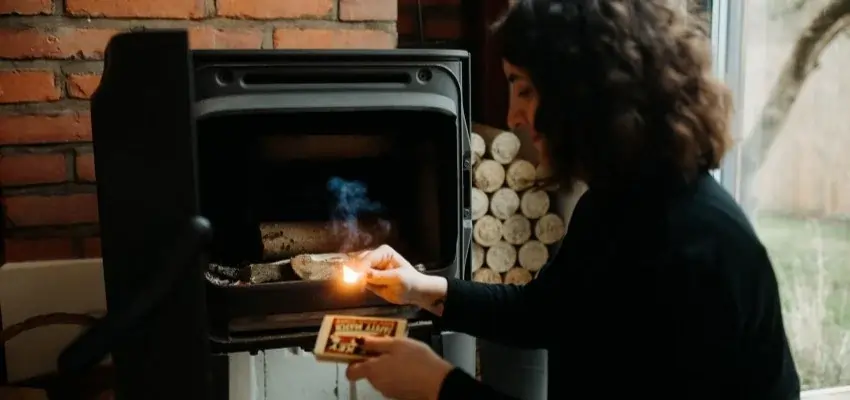
Two control designs set these wood stoves apart, and both affect how they are diagnosed. The Super series and Alderlea T5 use a linked secondary air control, which ties the secondary air supply to the main air control so that turning the stove down also reduces the secondary air. Larger models such as the Summit and Neo use what the maker calls EBT2, an extended burn system that manages air to keep long, clean burns going on a full load.
Both systems assume a sealed firebox, an intact baffle, and dry wood. A door gasket that has flattened, a cracked baffle board, or insulation that has slipped off the baffle lets uncontrolled air in, and the stove then burns faster or dirtier than its controls intend. When an owner tells us a stove that once held a fire all night now burns out in a few hours, we check those parts before assuming the control has failed.
Five problems account for most Pacific Energy service calls across Mission, and each has a cause we can usually confirm within minutes.
Burn times have shortened - flattened door or glass gaskets, a cracked baffle, or a baffle gasket that has hardened.
Glass blackens quickly - wet wood, a stove run too low for too long, or air wash flow blocked by ash.
Hole or crack in a rear air tube - years of hot fires; the secondary burn suffers until the tube is replaced.
Insert blower silent - a failed fan motor, a tripped thermal switch, or dust packed in the wheel on a Super or Summit insert.
Firebricks cracked or crumbling - normal wear in any firebox; bricks are replaced individually or as a set.
Stoves from this maker last a long time, and we still service early models such as the D-series Super Spectrum from the late 1980s. Older stoves usually have simpler controls and different gasket sizes, and many parts have been superseded by newer versions, which is why the series letter on the plate matters. A Summit, for example, was built as Series A and Series B, and trim and baffle parts differ between them.
On a current model, the brick set, baffle insulation kit, and gaskets are listed by model and series, and most remain easy to obtain. On an older one, we check whether the original part is still made or whether an approved replacement fits. A wood stove from this maker with straight steel, a sound door, and fresh gaskets keeps heating well for decades, and many owners in Mission are on their second or third set of bricks without ever needing a new stove.
Tell us whether the unit burns wood or gas, the model name, and the series letter if the plate shows one. Wood units are best seen before the first fire of autumn, when a sweep and gasket check set up the whole season. Gas units can be serviced any time, though the first cold weeks are the busiest. Chimney Sweep Mission technicians carry a gas licence and insurance for both fuels, and our first visit includes a full inspection with a written list of anything worn.
Call (778) 745-4769 to book, or contact us and send a picture of the plate. Chimney Sweep Mission will confirm a time and the parts we expect to bring.
Flue last swept long ago? Chimney Cleaning in Mission
Chimney Sweep visits that leave Mission living rooms clean
What's included in Chimney Sweep Services around Mission?
What Fireplace Experts check in your Mission chimney
Logs lifted, embers reset: Gas Fireplace Cleaning near Mission
Yearly Gas Fireplace Maintenance in Mission, before the cold arrives