Every repair leak-checked
A few quick answers help us understand your home, so we can give you a clear, upfront quote for Empire Comfort Systems Gas Fireplace Repair Mission
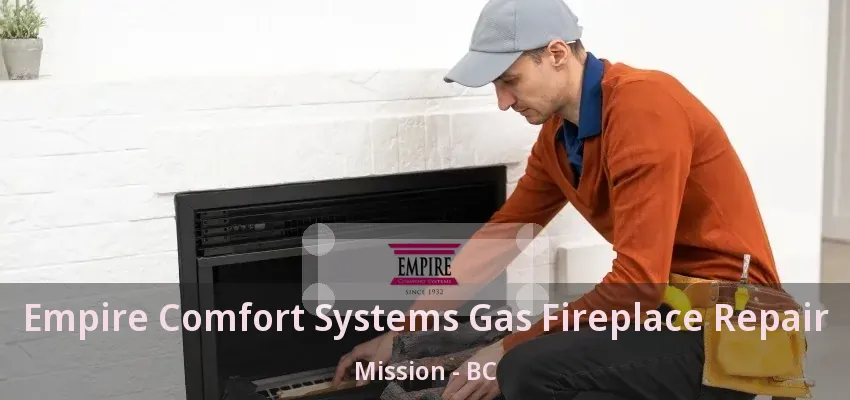
Chimney Sweep Mission sends a licensed gas technician to every gas fireplace repair call on these units, because a fix on the gas train is a measurement rather than a guess. The sections below explain what gets measured on an Empire unit, why the millivolt and intermittent pilot versions fail in different ways, and which smells mean stop and call.
Vent problems show up in the flame before they show up anywhere else, and this maker's four venting styles each fail in a recognizable way. On a direct-vent model, the coaxial pipe brings combustion air in through the outer passage and sends exhaust out through the inner one, so a termination cap crusted with snow or stuffed with a nest starves the fire. The flame turns lazy and orange, and an intermittent pilot unit may lose flame sensing and shut down. On a B-vent fireplace we smoke-test the draft hood with the clothes dryer and the bathroom fans running, since this style takes its air from the room and spills when the house is depressurized.
A vented log set burns inside a masonry fireplace with the damper clamped open, and we confirm the clamp is still fitted and the flue draws before any burner work begins. Vent-free models use an oxygen depletion sensor pilot that closes the valve when room oxygen falls. A pilot that keeps dropping out in a closed room is often that sensor doing its job, and these appliances are restricted or prohibited in many areas. Whatever the venting, a gas smell with the fire off is a leave-the-room situation: do not flip switches, get outside, and call the gas supplier and then us.
Gas-side faults on these fireplaces announce themselves at the pilot, at ignition, or at the remote, and each symptom points at a short list of parts. These are the ones our technicians across Mission are asked about most, with the usual cause behind each.
Pilot lights, then dies when the knob is released - a thermocouple tip sitting outside the flame or coated in carbon, or a pilot flame too small because the pilot orifice is partly blocked.
Burner lights with a delayed thump - gas pooling before ignition, caused by ember material over the ports, a carry-over tube knocked out of line, or low manifold pressure.
Remote shows power but the valve stays shut - a receiver with a loose spade at the TH terminals, or a receiver that has lost its code to the handset.
No spark on an intermittent pilot model - a cracked ceramic insulator on the electrode, a module without a good ground, or a spark gap wider than the specification.
Yellow, sooting flame after a propane changeover - the wrong orifice or regulator setting, which happens when a kit for the other ignition type was fitted.
Older Empire fireplaces with a standing pilot run on a millivolt valve with three terminals, marked TH, TP, and TH/TP, and the whole gas train works without a cord. Their repairs are mechanical: a pilot hood cleaned, a thermocouple or thermopile swapped, a valve replaced when the pressure readings prove it sticks. The pilot burns through the season, so the pilot assembly collects dust and spider webbing between visits.
Current intermittent pilot models spark the pilot on demand and hold a battery backup for outages, and their repairs are electrical first: the module, the sensing rod, the wiring, and the battery tray. Because the same model was sold with either ignition over the years, the year of the house tells us little; the ignition code on the rating plate tells us everything. A millivolt valve whose pilot end is kept clean and dry at each annual service routinely outlasts two thermopiles, which is why a gas fireplace repair on an older unit is often cheaper than owners expect.
Every gas repair on one of these units follows the same order so that nothing is replaced on a hunch. We check inlet pressure and then manifold pressure at the valve test port with a manometer, and compare both against the rating plate for the fuel in use. Every joint from the shut-off to the burner gets a leak solution test. The pilot flame is adjusted until it wraps the thermocouple and the thermopile or sensing rod, and on millivolt units the thermopile reading is taken with the valve calling for heat, not at rest.
Then the burner itself: ports cleared of ember debris, the ember material laid back in the pattern the manual shows, and the flame photographed. On the Renegade, an external air control lets us fine-tune the flame mix without opening the firebox, a detail unique to that model. A burner flame that lifts, floats, or burns with yellow tips after this sequence tells us the venting section above needs another look.
Before you call for Empire Comfort Systems Gas Fireplace Repair Mission, note three things: whether the pilot is lit or will light, whether the unit runs on natural gas or propane, and whether you noticed any smell with the fire off. Those answers decide whether the first visit is a diagnosis or a parts run. We carry a licence for gas appliance work and insurance for it, and the pilot assembly, valve, and module parts for these units are ordered against your plate.
Homeowners throughout Mission can reach a technician at (778) 745-4769, and anyone who prefers email can contact us online with the plate photo and the fuel type. Chimney Sweep Mission will come back with a time and an estimate for the first visit.
Flue last swept long ago? Chimney Cleaning in Mission
Chimney Sweep visits that leave Mission living rooms clean
What's included in Chimney Sweep Services around Mission?
What Fireplace Experts check in your Mission chimney
Logs lifted, embers reset: Gas Fireplace Cleaning near Mission
Yearly Gas Fireplace Maintenance in Mission, before the cold arrives